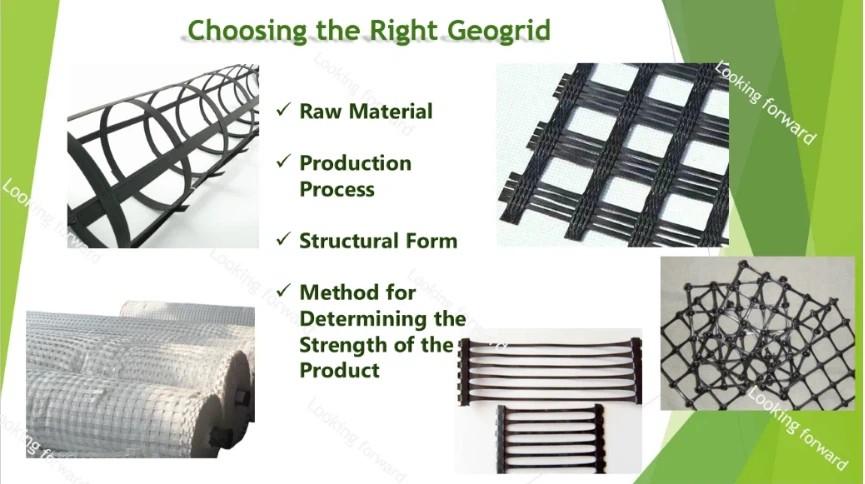
Geogrids play a crucial role in modern construction by enhancing soil structure stability and load-bearing capacity. Widely used in road construction, embankments, retaining walls, and slopes, geogrids provide significant benefits. This article offers an in-depth exploration of geogrid reinforcement, including types of geogrids, design considerations, installation methods, technical parameters, product selection criteria, construction considerations, and project case studies to help construction professionals better understand and apply geogrid technology.
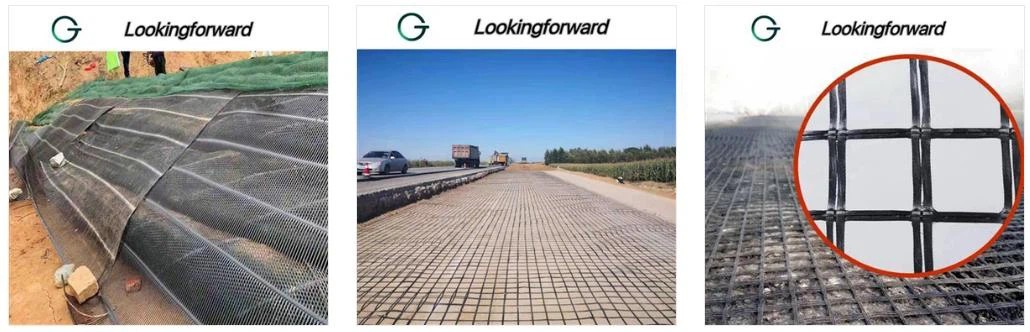
1. Types of Geogrids
1.1 Unidirectional Geogrids
Unidirectional geogrids are designed to provide high tensile strength in one direction, suitable for applications requiring strength in one direction, such as embankments and retaining walls. Key features include:
High Tensile Strength: Typically ranging from 30 to 100 kN/m.
Low Elongation: Typically less than 5%, offering stability and preventing excessive deformation.
1.2 Bidirectional Geogrids
Bidirectional geogrids provide tensile strength in both horizontal and vertical directions, suitable for applications needing reinforcement in both directions, such as foundation stabilization and lower layer support. Key features include:
Equal Strength in Both Directions: Tensile strength typically ranging from 10 to 50 kN/m.
Moderate Elongation: Elongation typically between 5-10%, providing a balance between strength and flexibility.
1.3 Triaxial Geogrids
Triaxial geogrids provide reinforcement in multiple directions, suitable for complex soil stabilization and reinforcement projects. Commonly used in road construction and embankments. Key features include:
Multi-Directional High Strength: Tensile strength typically ranging from 30 to 80 kN/m.
Enhanced Soil Interaction: Improves lock-in with soil, enhancing overall stability.
1.4 Geocomposite Materials
Geocomposite materials combine geogrids with other geosynthetics (such as geotextiles) to provide additional functions like filtration and drainage. Key features include:
Combined Functions: Provides reinforcement, filtration, and drainage in a single product.
Versatile Applications: Used in various construction applications, including roads and retaining walls.
Bidirectional geogrid and UD geogrid with TDS
2. Design Considerations
The design of a geogrid reinforcement system is crucial for ensuring project stability and durability. Key design considerations include load-bearing capacity, reinforcement mechanisms, environmental factors, and installation methods. Below, we provide detailed parameters and data for these factors.
2.1 Load-Bearing Capacity
The design of load-bearing capacity directly affects the overall performance of the geogrid reinforcement system. Key parameters to consider:
2.1.1 Soil Bearing Capacity
Soil bearing capacity is fundamental for assessing geogrid design. It is typically expressed as maximum load per unit area, measured in kN/m². Key parameters include:
Soil Type: Different soil types such as clay, sand, and gravel have different bearing capacities.
Soil Compaction: Affects soil shear strength and bearing capacity. Compaction is determined using standard consolidation tests (e.g., Proctor test).
Soil Friction Angle: Influences soil stability, typically ranging from 25 to 45 degrees.
Example Data:
Clay: Maximum bearing capacity of 100-200 kN/m².
Sand: Maximum bearing capacity of 150-300 kN/m².
Gravel: Maximum bearing capacity of 300-500 kN/m².
2.1.2 Geogrid Bearing Capacity
The bearing capacity of geogrids directly impacts their reinforcement effectiveness. Key parameters include:
Tensile Strength: Maximum tensile strength in the direction of load, measured in kN/m. Typical range is 30-100 kN/m.
Elongation: Amount of deformation when stretched, typically less than 5%.
Shear Strength: Shear strength at the geogrid-soil interface, usually measured through testing.
Example Data:
Unidirectional Geogrid: Tensile strength of 50 kN/m, elongation of 4%.
Bidirectional Geogrid: Tensile strength of 30 kN/m, elongation of 7%.
Triaxial Geogrid: Tensile strength of 40 kN/m, elongation of 6%.
2.2 Reinforcement Mechanism
Geogrids enhance soil stability by increasing shear strength and optimizing load distribution.
2.2.1 Increased Shear Strength
Geogrids enhance soil shear strength to prevent slope failures and settlement. Key parameters include:
Geogrid Layout: Spacing and orientation of geogrid layers affect reinforcement effectiveness. Common layouts are spaced at 0.5 meters or 1 meter.
Soil-Geogrid Interface Friction Coefficient: Determines the frictional resistance between the geogrid and soil, typically between 0.5 and 0.75.
Example Data:
Geogrid Layout Spacing: 0.5 meters, providing denser reinforcement.
Interface Friction Coefficient: 0.6, enhancing overall stability.
2.2.2 Load Distribution Optimization
Geogrids distribute applied loads over a larger area to reduce soil pressure. Key parameters include:
Number of Layers: Increasing the number of geogrid layers improves load distribution. Commonly 2 to 4 layers.
Covering Material Thickness: Affects load distribution uniformity, typically ranging from 0.1 to 0.3 meters.
Example Data:
Number of Layers: 2 layers, suitable for moderate load applications.
Covering Material Thickness: 0.2 meters, providing good load distribution.
2.3 Environmental Factors
Environmental conditions significantly impact the long-term performance of geogrid reinforcement systems. Design should consider the following factors:
2.3.1 Temperature Extremes
Geogrid performance varies under different temperatures. Common temperature ranges and their impacts:
Low Temperatures: Geogrid materials may become brittle. Choose low-temperature-resistant materials, such as modified polyester.
High Temperatures: High temperatures may cause thermal expansion. Choose high-temperature-resistant materials, such as polypropylene.
Example Data:
Low-Temperature Limit: -20°C, ensuring material does not become brittle.
High-Temperature Limit: 70°C, ensuring material does not deform.
2.3.2 Chemical Exposure
The durability of geogrids in chemically corrosive environments depends on material chemical resistance. Key factors include:
Acidity/Alkalinity: Soil pH can affect geogrid lifespan. Choose acid/alkali-resistant materials, such as coated polyester.
Salinity: High salinity environments (e.g., coastal areas) may cause material degradation. Choose salt-resistant materials, such as galvanized steel.
Example Data:
Acidic Environment pH Range: 2-5, select acid-resistant materials.
Salinity Concentration: 3%, select salt-resistant materials.
2.4 Construction and Installation
Proper construction and installation practices are essential for the effectiveness of geogrid reinforcement systems. Key parameters and considerations include:
2.4.1 Subgrade Preparation
Ensure the subgrade is adequately compacted and cleared. Key parameters include:
Subgrade Compaction: Typically required to achieve 95% Standard Proctor Dry Density (SMD).
Subgrade Smoothness: Surface irregularity should be less than 5 millimeters to ensure even geogrid placement.
Example Data:
Subgrade Compaction: 95% SMD, ensuring subgrade stability.
Subgrade Smoothness: <5 millimeters, ensuring smooth placement.
2.4.2 Geogrid Placement
Geogrids should be installed according to design specifications to ensure effective reinforcement. Key parameters include:
Placement Tension: Should be adjusted according to design requirements to avoid excessive deformation or wrinkling. Typical tension range is 10-15 kN/m.
Alignment Accuracy: Ensure geogrid placement alignment deviation does not exceed 10 millimeters.
Example Data:
Placement Tension: 10-15 kN/m, maintaining uniform tension.
Alignment Deviation: ≤10 millimeters, ensuring precise placement.
2.4.3 Quality Control
Quality control measures during construction ensure that geogrid installation meets project specifications. Key parameters include:
Inspection Frequency: Inspect every 10 meters during construction.
Testing Items: Include tensile testing, elongation testing, and installation quality checks.
Example Data:
Inspection Frequency: Every 10 meters, ensuring construction quality.
Testing Items: Including tensile strength testing and elongation testing, ensuring material performance.
3. Product Technical Parameter Table
The following table summarizes the technical parameters for different types of geogrids for easy reference:
4. Product Selection Criteria
When selecting the appropriate geogrid product, consider the following factors:
Project Requirements: Determine specific project requirements, including load-bearing needs, environmental conditions, and construction requirements.
Soil Type: Choose geogrids that match soil characteristics.
Cost Budget: Select products based on project budget, balancing material performance and cost.
Long-Term Performance: Ensure selected products have good durability to meet long-term usage requirements.
5. Construction Considerations
Consider the following factors during construction:
Subgrade Preparation: Ensure subgrade compaction and smoothness meet design requirements.
Placement Quality: Maintain geogrid tension and alignment accuracy, avoiding wrinkles and unevenness.
Quality Control: Implement strict quality control measures to ensure material performance meets specifications.
6. Project Case Studies
6.1 Road Foundation Reinforcement
Project Overview: Reinforcement of a suburban road foundation, with a total length of 5 kilometers and a width of 10 meters.
Usage Period: June 2022 to March 2023.
Materials Used: Unidirectional geogrid with a tensile strength of 50 kN/m.
Design Considerations: Geogrid placed at 1-meter intervals to enhance foundation load-bearing capacity.
Performance: The reinforced road foundation demonstrated improved load distribution and reduced pavement distress.
6.2 Retaining Wall
Project Overview: Construction of a drainage channel retaining wall in an urban area, with a total height of 10 meters and a load-bearing capacity of 500 kN/m².
Usage Period: September 2022 to March 2023.
Materials Used: Unidirectional geogrid with a tensile strength of 70 kN/m.
Design Considerations: Geogrid placed at 1-meter intervals to provide stability and prevent sliding.
Performance: The retaining wall successfully retained soil and resisted lateral pressure without deformation.
6.3 Slope Stabilization
Project Overview: Slope stabilization project in a mining area, with a total height of 15 meters and an average slope of 30 degrees.
Usage Period: April 2023 to October 2023.
Materials Used: Triaxial geogrid with a tensile strength of 40 kN/m.
Design Considerations: Geogrid installed in a staggered pattern to provide multi-directional reinforcement.
Performance: The stabilized slope showed significant erosion reduction and improved stability during heavy rainfall.
Geogrid reinforcement technology plays a vital role in modern construction. By understanding different types of geogrids, design considerations, installation methods, technical parameters, product selection criteria, construction considerations, and case studies, construction professionals can effectively apply geogrid technology to enhance project stability and long-term performance. Proper design and installation, combined with regular maintenance, are key to achieving successful reinforcement and ensuring long-term project benefits.
Our factory specializes in producing high-quality geogrids suitable for various construction applications. We offer a range of products, including unidirectional, bidirectional, and triaxial geogrids, as well as geocomposite materials, to meet different project needs. Our geogrids not only comply with international standards but are also subjected to strict quality control to ensure reliability and durability under various environmental conditions. If you are interested in our products or have any questions, please feel free to contact us. We provide professional technical support and services to meet your needs.