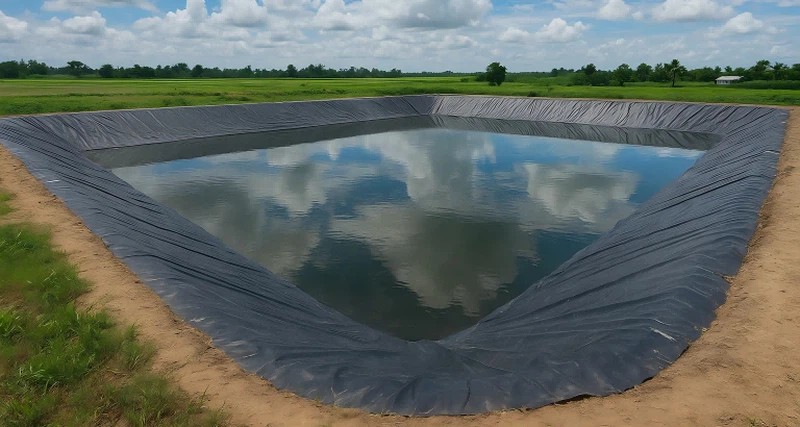
PVC Geomembrana Pond Lining Solution For Agricultural Projects in The Philippines
1. Project Background
This project is located in Nueva Ecija Province, northern Luzon, Philippines — a region known for rice farming and aquaculture.
Due to high soil permeability and intense rainy seasons, the farm cooperative faced persistent issues such as pond leakage, unstable water levels, and increased maintenance costs.
To ensure long-term water retention and environmental safety, the client decided to use PVC geomembrana as the core waterproofing material for their 5,000 m² multifunctional pond, designed for both irrigation and tilapia farming.
Key technical requirements included:
Permeability coefficient ≤ 1.0 × 10⁻¹³ cm/s
Service life ≥ 20 years
Flexibility between 15–38°C (tropical temperature range)
Non-toxic and fish-safe composition
2. Material Selection and Specifications
After evaluating local soil conditions, climate, and budget, qdlookingforward provided a tailored PVC geomembrana configuration.
Before shipment, every batch underwent rigorous testing — including tensile strength, tear resistance, seam shear test, and low-temperature flexibility (-20°C) — to guarantee compliance with project standards.
PVC geomembrana rolls ready for installation
3. Installation Process
The installation took approximately 9 days and was executed under the supervision of a qdlookingforward technical engineer.
Step 1: Subgrade Preparation
Removal of debris and sharp objects
Manual compaction of the base
Application of a 10 cm fine sand layer for surface leveling
Step 2: Geotextile Protection Layer
A 300 g/m² nonwoven geotextile was laid beneath the membrane to protect it from puncture damage.
Step 3: PVC Geomembrana Laying
Unrolled using a mechanical spreader
Overlapping width of 10 cm between sheets
Oriented in the same direction to avoid wrinkles or air pockets
Step 4: Welding and Sealing
Dual-track hot air welding with a 30 mm test channel
Air pressure testing of seams for quality control
Final weld acceptance rate reached 99.6%
Step 5: Anchor Trench
Excavated 40 cm deep × 30 cm wide anchor trench around the perimeter
Backfilled and compacted after membrane placement
Step 6: Inspection and Acceptance
The final inspection included air channel pressure testing, 24-hour water retention trial, and visual surface checks, all meeting project standards.
Hot-air double seam testing and inspection during installation
4. Project Performance and Results
After completion, the pond was filled and monitored over a 3-month evaluation period.
Results demonstrated exceptional waterproofing and material performance:
Water level loss < 1 mm/day (mostly evaporation)
No leakage, blistering, or peeling observed
Water pH remained stable within ±0.3
Tilapia survival rate exceeded 96%
Farm owners also noted that PVC geomembrana’s flexibility accommodated minor ground settlement without cracking — a significant advantage over HDPE liners, which are more rigid and harder to weld consistently.
Overall, the PVC geomembrana solution reduced total project cost by 12% while maintaining high sealing integrity.
Completed pond lined with PVC geomembrana under tropical conditions
5. Key Takeaways
This project demonstrates that PVC geomembrana is a cost-effective, durable, and flexible solution for pond waterproofing, particularly in tropical regions like the Philippines.
PVC liners are ideal for:
Agricultural irrigation reservoirs
Aquaculture ponds and fish farms
Rainwater collection basins
Small-scale wastewater or tailings ponds
As a professional Chinese PVC geomembrana manufacturer, qdlookingforward continues to supply customized waterproofing solutions and technical guidance for global clients — ensuring long-term project reliability from design to installation.