
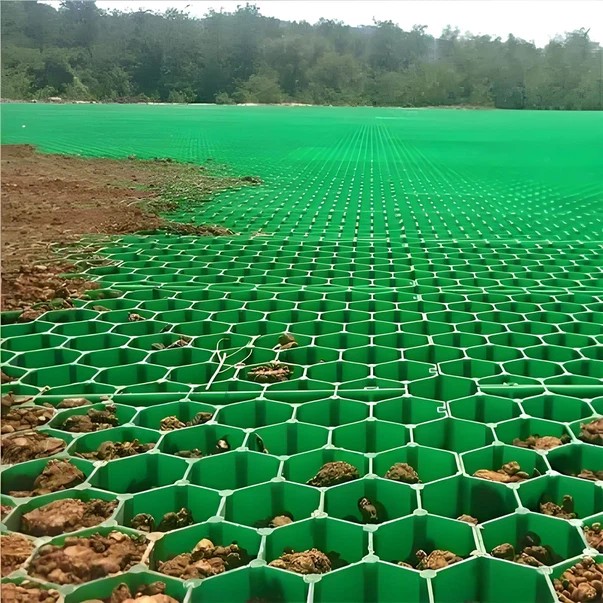
Grass pavers are an eco-friendly, economical, and aesthetically pleasing ground paving material widely used in parking lots, fire lanes, green belts, rooftop gardens, and other areas. This article will detail the selection and construction methods of grass pavers, combined with specific indicators and engineering data.
I. Selection of Grass Pavers
1. Material Selection
Grass pavers are commonly made of polyethylene (PE) and polypropylene (PP). The performance of each material is as follows:
Polyethylene (PE): Offers excellent toughness and impact resistance, suitable for areas that frequently endure vehicle traffic, such as parking lots and fire lanes.
Polypropylene (PP): Provides higher compressive strength and heat resistance, ideal for green projects in high-temperature environments, such as rooftop gardens and sun-exposed open parking lots.
2. Specification Selection
Grass paver specifications include unit cell size, thickness, and porosity. Below are some common specifications and their application scenarios:
Unit cell size 330mm x 330mm, thickness 38mm: Suitable for general landscaping projects, such as park lawns and courtyard greening.
Unit cell size 500mm x 500mm, thickness 50mm: Suitable for areas requiring higher load-bearing capacity, such as parking lots and fire lanes.
Porosity 40%: Suitable for areas requiring high water permeability, such as roadside slopes and green belts.
3. Load-bearing Capacity
The load-bearing capacity of grass pavers is a key indicator when selecting the appropriate type. Different load-bearing capacities are chosen based on application scenarios:
Load-bearing capacity 200 tons/square meter: Suitable for small vehicle parking lots and walkways.
Load-bearing capacity 300 tons/square meter: Suitable for medium vehicle parking lots and fire lanes.
Load-bearing capacity 400 tons/square meter and above: Suitable for heavy vehicle traffic areas, such as large parking lots and logistics pathways.
II. Construction Methods of Grass Pavers
1. Base Layer Treatment
Before construction, the base layer should be treated to ensure it is flat and solid, typically with a compaction degree of over 90%. In underground projects, the base should have a certain slope (generally 1-2%) to facilitate drainage.
2. Laying the Cushion Layer
A gravel cushion layer, typically 10-15 cm thick, is laid on the base. The cushion should be evenly spread and compacted to ensure flatness and density.
3. Laying Grass Pavers
Laying Direction: Grass pavers should be laid according to the design direction, usually from bottom to top and along the slope.
Connection Method: The cells of grass pavers are connected by interlocking, ensuring firm connections. Adjustments should be made during laying to ensure overall flatness.
Anchoring: In projects with steep slopes, grass pavers should be anchored with nails or strips, with an anchoring point spacing of 50-100 cm.
4. Filling Soil
After laying the grass pavers, fill them with soil immediately. The filling soil should be fertile topsoil, rich in organic matter, suitable for turf growth. Fill evenly, slightly above the cell surface by 1-2 cm.
5. Turf Planting
After filling the soil, plant the turf immediately. Common turf varieties include ryegrass and bermudagrass. After seeding, lightly press and water to ensure good contact between seeds and soil, promoting germination.
6. Maintenance Management
After planting, conduct regular watering, fertilizing, and weeding. Initially, keep the soil moist to promote rapid turf growth. Once established, regularly trim and maintain the turf to keep it attractive and functional.
III. Engineering Example and Data Analysis
Below is an example of a grass paver construction for a parking lot:
Project Overview: A large parking lot, covering 8000 square meters, requiring both parking and greening functions.
Material Selection: Polyethylene grass pavers with unit cell size 500mm x 500mm, thickness 50mm, and load-bearing capacity of 300 tons/square meter.
Construction Process: Base treatment → Gravel cushion layer laying → Grass paver laying → Soil filling → Turf planting → Maintenance management.
Engineering Data Analysis
Laying Speed: Approximately 800 square meters of grass pavers can be laid per day, requiring 10 days to complete the entire parking lot.
Load Capacity: The selected material can support up to 1000 vehicle trips per hour, ensuring normal parking lot usage.
Drainage Performance: With a porosity of 40%, the grass pavers can effectively absorb water, with an hourly drainage capacity of 32,000 liters, ensuring no water accumulation in the parking lot.
IV. Conclusion
Choosing the right grass pavers and following standardized construction methods can significantly improve the green effect and lifespan of a project. When selecting grass pavers, factors such as material, specifications, load-bearing capacity, and porosity should be comprehensively considered. During construction, adhering to process workflows ensures the quality of each step.
V. Product Promotion and Marketing
Our company is dedicated to providing high-quality grass paver products. With years of industry experience and advanced production technology, our grass pavers offer the following advantages:
Premium Materials: Made from imported polyethylene (PE) and polypropylene (PP), ensuring excellent compressive strength and durability, suitable for various complex engineering environments.
Diverse Specifications: We offer a wide range of specifications and models to meet different requirements, widely used in parking lots, fire lanes, rooftop gardens, and green belts.
Eco-friendly Design: Our grass pavers are designed with environmental factors in mind, featuring high porosity for superior drainage and promoting healthy turf growth, creating green ecological environments.
Easy Installation: The product design is ergonomic, making installation simple and quick, reducing construction time and labor costs, and improving project efficiency.
Comprehensive Service: We provide not only quality products but also comprehensive technical support and after-sales service, ensuring the smooth completion of each project and customer satisfaction.
Choosing our grass paver products will not only enhance project quality but also contribute to environmental protection. We welcome friends from all walks of life to contact us for consultation and on-site inspections. We are committed to providing excellent service and working together to create a green, ecological, harmonious, and beautiful environment.