
1. Introduction: Why Installation Quality Matters
PVC geomembrana, also known as PVC geotechnical membrane or plastic waterproofing film, is a flexible polymer sheet widely used for seepage prevention in reservoirs, mining ponds, landfills, and irrigation projects.
While material quality is crucial, installation workmanship determines 70% of the system's final performance. A high-quality geomembrane can fail if improperly installed; conversely, even a mid-range membrane performs well with correct procedures.
2. Site Preparation and Subgrade Treatment
Before any PVC geomembrana is laid, the subgrade must be carefully prepared:
Cleaning and leveling: Remove all sharp stones, roots, or construction debris. The surface must be smooth and free of irregularities.
Compaction: Achieve uniform density (generally 85–90%) to prevent uneven settlement.
Slope shaping: Slopes are trimmed according to design requirements; transitions between base and sidewalls must be rounded with a minimum radius of 10 cm.
Protective layer: In some cases, a layer of geotextile or sand cushion is laid under the PVC geomembrana to protect it from puncture.
Proper groundwork is the foundation of successful waterproofing.
3. PVC Geomembrana Unrolling and Positioning
After subgrade preparation:
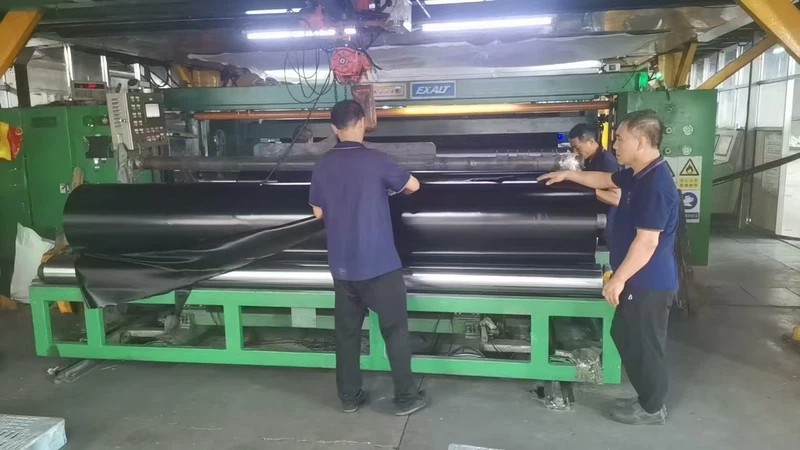
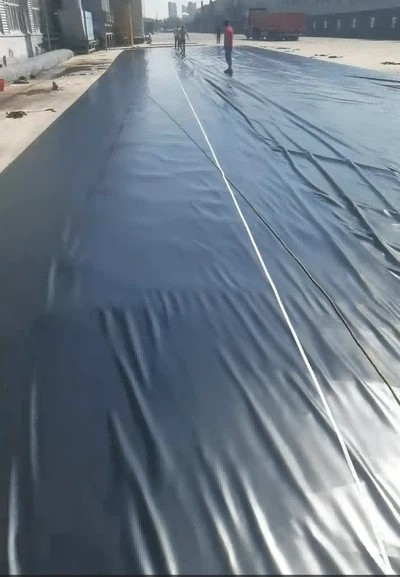
Unroll the geomembrane carefully along the designed direction, minimizing wrinkles and tension.
Ambient temperature: Best installation temperature is 5–40 °C. Avoid installation during strong wind or rain.
Overlap width: Adjacent sheets should overlap by 10–15 cm to allow for secure hot-wedge welding.
Numbering: Each sheet is marked for easy tracking during quality inspection.
During this stage, installers use sandbags or soft weights to hold down the sheets temporarily.
4. Welding and Seaming Process
Welding is the most critical step of the entire installation.
PVC geomembrana is usually joined by hot wedge or hot air welding, ensuring a strong, homogeneous joint.
Equipment: Use certified automatic wedge welders and handheld extrusion guns.
Temperature control: Typically 350–450 °C for automatic welding (depending on sheet thickness).
Dual-track welding: Creates two parallel seams with an air channel in between for air pressure testing.
Manual welding: Used for corners, details, or difficult-to-reach areas.
All operators must be trained and certified to guarantee consistent seam quality.
5. Seam Inspection and Testing
To ensure watertight integrity, each weld is thoroughly inspected:
Visual inspection: Check for uniform color, smooth edges, and no burnt marks.
Air pressure test: Inject compressed air (usually 0.2 MPa) into the test channel between the dual seams and monitor for 5 minutes.
Vacuum testing: Apply soapy solution on the weld surface and check for air bubbles under vacuum bell.
Destructive testing: Randomly cut test samples to measure tensile and shear strength, ensuring it meets design standards (≥ 90% of virgin material strength).
All test results should be recorded in the construction log.
6. Detail Treatment: Corners, Pipes, and Anchoring Trenches
Critical points are where leakage often occurs - therefore they require special care:
Corners and joints: Pre-fabricated corner pieces or hand-welded strips are used to ensure full coverage.
Pipe penetrations: PVC sleeves and extrusion welding create a tight, integral seal.
Anchoring trenches: At the top of slopes, geomembrane edges are buried in anchor trenches (typically 30 cm × 30 cm) to prevent slippage.
Every detail affects long-term reliability.
7. Protective Layers and Covering
Once welding and inspection are completed:
A protective geotextile or sand layer (≥ 30 cm thick) is placed on top of the geomembrana.
Heavy machinery should avoid direct contact with the membrane during covering.
Covering is performed immediately after welding to prevent UV degradation or wind damage.
8. Construction Quality Control
Professional installation teams, such as those from Chinese PVC geomembrana manufacturers, often follow ISO 9001-certified quality management systems.
Key controls include:
On-site supervision and daily record-keeping.
Strict storage and handling procedures to prevent damage.
Real-time temperature and humidity monitoring during welding.
Separate logs for each roll (batch number, length, operator, test result).
Such rigorous management ensures that exported projects meet international specifications.
9. Acceptance and Documentation
Final acceptance consists of:
Visual acceptance – no damage, wrinkles, or exposed joints.
Testing acceptance – all seam tests passed, sample results recorded.
Documentation – includes material certificates, welding logs, inspection forms, and "as-built" drawings.
Only after all criteria are verified can the PVC geomembrana system be approved for backfilling or commissioning.
10. Maintenance and Long-Term Performance
Even the best geomembrane needs maintenance:
Avoid mechanical punctures from later construction.
Inspect slopes and seams annually for exposure or tension.
If minor damage occurs, patching with compatible PVC material via extrusion welding restores waterproof integrity.
Proper drainage systems above and below the liner extend service life beyond 25 years.
11. Conclusion
PVC geomembrana installation is a precise engineering process that combines materials science, temperature control, and strict inspection.
From subgrade treatment to final acceptance, every step contributes to long-term impermeability and corrosion resistance.
As one of the leading Chinese PVC geomembrana manufacturers, we emphasize not only producing high-quality membranes but also providing professional installation guidance and international technical support.
A well-installed PVC geomembrana is not just a lining - it's the foundation of sustainable waterproofing for decades to come.