
Geotextile rolls should be protected from damage before installation and unfolding and be stacked in a flat and water-free place, with a height of no more than four rolls. Geotextile fabric rolls must be covered with opaque material to prevent UV aging. During the storage process, it is necessary to keep the label intact and the information complete. During transportation, geotextile rolls must be protected from damage. Geotextile rolls that have been physically damaged must be repaired, and geotextiles that have been severely worn cannot be used in various projects. Any geotextile that comes into contact with leaking chemical reagents is not allowed to be used in engineering.
Geotextile Installation Method
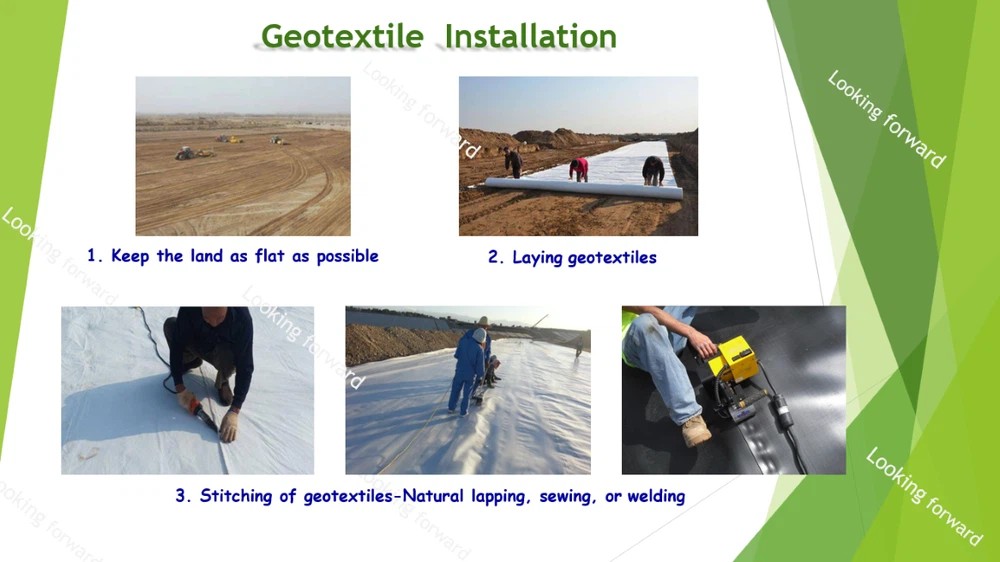
1. Manually roll the cloth surface and leave a deformation margin appropriately.
2. The installation of filament or short filament geotextiles usually uses lapping, stitching and welding. The width of stitching and welding is generally more than 0.1m, and the width of lap is generally more than 0.2m. Geotextiles that may be exposed for a long time should be welded or stitched.
3. Stitching of geotextiles:
All sutures must be done consecutively. Before overlapping, the geotextiles must overlap at least 150mm. The minimum stitch distance from the knitting edge (exposed edge of the material) is at least 25 mm.
The sewn geotextile seam consists of a 1-row wired lock chain seam method. The threads used for suturing should be resin materials with a minimum tension of more than 60N and have chemical and UV resistance comparable to or superior to that of geotextiles.
Any "missing stitches" on the sewn geotextile must be re-stitched where they are affected.
Appropriate measures must be taken to avoid soil, particulate matter or foreign substances entering the geotextile layer after installation.
The lap of cloth can be divided into natural lap, sewing or welding according to the terrain and the function of use.
4. In construction, the geotextile on the geomembrane adopts natural lap joint, and the geotextile on the upper layer of the geomembrane adopts seam or hot air welding. Hot air welding is the preferred connection method of filament geotextiles, that is, the connection of two pieces of cloth is heated at a high temperature instantaneously with a heat gun, so that part of it reaches a molten state, and a certain external force is immediately used to make it firmly bonded together. In the case that the hot adhesive connection cannot be carried out in wet (rain and snow) weather, the geotextile should adopt another method - the suture connection method, that is, the double thread stitching connection is carried out with a special sewing machine, and the suture thread that resists chemical ultraviolet rays is used.
The minimum width is 10 cm for stitching, 20 cm for natural lap joints, and 20 cm for hot air welding.
5. For seams, the suture with the same quality as the geotextile should be used, and the suture should be made of materials with stronger resistance to chemical damage and ultraviolet light irradiation.
6. After the geotextile is laid, the geomembrane will be laid after the approval of the on-site supervision engineer.
7. The geotextile on the geomembrane is laid on the same as above after the geomembrane is approved by Party A and the supervisor.
8. The corresponding numbers of the geotextiles of each layer are TN and BN.
9. The upper and lower layers of the membrane should be buried in the anchoring groove together with the geomembrane in the parts with the anchoring groove.
The Basic Requirements for Geotextile Installation
1. The joint must intersect with the slope line; Where there is balance with the foot of the slope or where there may be stress, the distance between the horizontal joints must be greater than 1.5m.
2. On the slope, anchor one end of the geotextile, and then put down the membrane on the slope to ensure that the geotextile remains tight.
3. All geotextiles must be pressed with sandbags, which will be used during laying and retained to lay a layer of material above.
Geotextile Laying Process Requirements
1. Grassroots inspection: check whether the grassroots is smooth and solid, and if there is a foreign object, it should not be properly handled.
2. Test paving: According to the site situation, determine the size of the geotextile, and test pave it after cutting, and the cutting size should be accurate.
3. Check whether the width of the salad is appropriate, and the lap joint should be flat and moderately tight.
4. Positioning: Use a hot air gun to bond the overlapping parts of the two geotextiles, and the spacing of the bonding points should be appropriate.
5. When suturing the lap part, the suture line should be straight and the stitches should be even.
6. After stitching, check whether the geotextile is laid smoothly and whether there are defects.
7. If there is a phenomenon that does not meet the requirements, it should be repaired in time.
Self-Test and Repair
a. All geotextile pieces and joints must be checked. Defective geotextile sheets and stitches must be clearly marked on the geotextile and repaired.
b. The worn geotextile must be repaired by laying and thermally connecting small pieces of geotextiles, which are at least 200mm longer than the edge of the defect in all directions. The thermal connection must be strictly controlled to ensure that the geotextile patch and the geotextile are tightly integrated and that there is no damage to the geotextile.
c. Before the end of each day, visually inspect all the geotextile surfaces laid on the day to ensure that all damaged places have been marked and repaired immediately, and make sure that there are no foreign substances that may cause damage on the laying surface, such as fine needles and small iron nails.
d. The following technical requirements should be met when repairing geotextile damage:
e. The patch material used to fill holes or cracks should be consistent with the geotextile.
f. The patch should extend at least 30 cm beyond the scope of the damaged geotextile.
g. At the bottom of the landfill, if the geotextile crack exceeds 10% of the width of the membrane, the damaged part must be removed, and then the two geotextiles are connected; If the tear on the slope exceeds 10% of the width of the coil, the roll of geotextile must be removed and replaced with a new roll.
h. The work shoes worn by the construction personnel and the construction equipment used should not damage the geotextile, and the construction personnel shall not do anything that may harm the geotextile on the geotextile that has been laid, such as smoking or poking the geotextile with sharp tools.
i. For the safety of geotextile materials, the packaging film should be opened before laying the geotextile, that is, a roll should be laid and a roll should be opened. And inspect the appearance quality.
J. In particular, it is proposed that after the geotextile arrives at the site, it is necessary to carry out acceptance and visa recognition in a timely manner.
Precautions for Geotextile Installation and Construction
1. Geotextiles can only be cut with geotextile knives (hook knives), if cut in the site, special protective measures must be taken for other materials to prevent unnecessary damage caused by cutting geotextiles;
2. While laying the geotextile, all necessary measures must be taken to prevent damage to the material below;
3. When laying geotextiles, care must be taken not to let stones, a large amount of dust or moisture and other substances that may damage the geotextiles, may block the drainage channels or filter screens, or may bring difficulties to the next connection into the geotextiles or under the geotextiles;
4. After the installation, visually inspect all geotextile surfaces to determine all damaged landlords, mark them and repair them, and make sure that there are no foreign substances that can cause damage on the laying surface, such as broken needles and other foreign objects;
5. The connection of geotextile must comply with the following provisions: under normal circumstances, there can be no horizontal connection on the slope, except for the repair place.
6. If suture is used, the suture line must be made of the same or more material than the geotextile material, and the suture line must be a material resistant to chemical ultraviolet rays. There should be a significant color difference between the suture and the geotextile for easy inspection.
7. Pay special attention to the stitching during installation to ensure that no soil or gravel in the gravel overburden enters the middle of the geotextile.
Damage and Repair of Geotextiles
1. At the joint of the suture, it is necessary to re-suture and repair, and ensure that the end of the skipping part has been re-sutured.
2. In all areas, except for rocky slopes, holes or tears must be repaired and stitched with geotextile patches of the same material.
3. At the bottom of the landfill, if the length of the crack exceeds 10% of the width of the membrane, the damaged part must be cut off, and then the two parts of the geotextile are connected.